
Skills Ontology
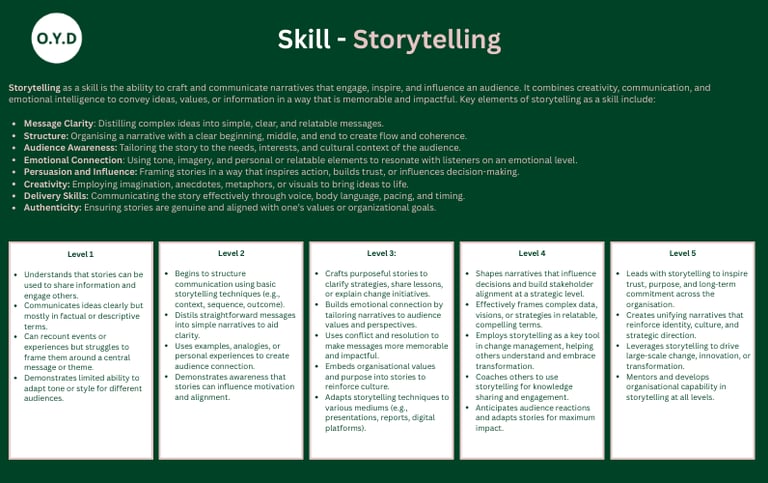
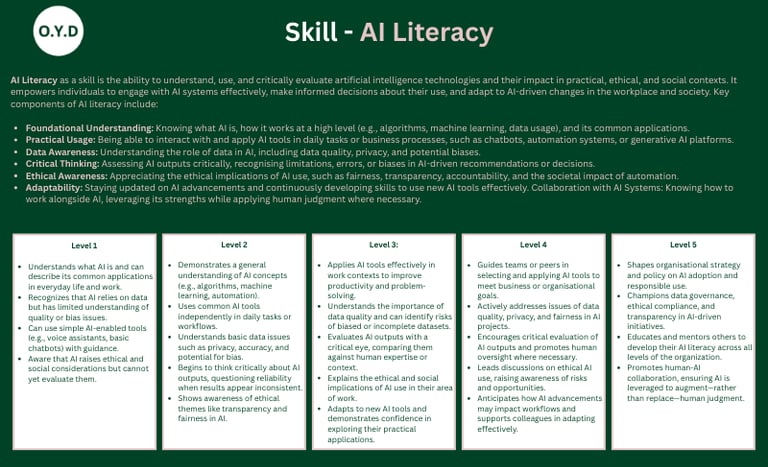
We have developed our own comprehensive skills ontology. We define a skill then break it down into what someone would be expected to demonstrate at each level.
Why 5? Five offers the optimal balance, comprehensive enough to capture meaningful progression, yet focused enough to remain practical. When we partner with your organisation, these skill definitions and levels become the foundation of your bespoke skills ontology, tailored to reflect your unique strategy, culture, and capability goals
Click below to see an example of our skills.
Skill Development
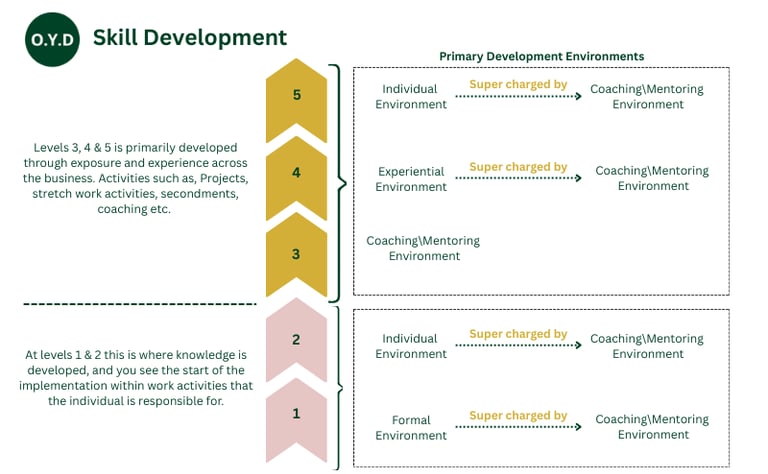
At O.Y.D, we champion a progressive layering approach to skills development, one that aligns with how people truly learn, grow, and perform. Our five-level framework maps the journey from foundational knowledge to strategic capability, blending four core development environments: Individual, Formal, Coaching/Mentoring, and Experiential.
This model reflects the reality that skills are not built in isolation, they are layered, reinforced, and accelerated through intentional design.
How It Works:
Levels 1 & 2 focus on knowledge acquisition and early application, supported by Formal and Individual environments, supercharged by Coaching/Mentoring to deepen understanding and embed learning.
Levels 3 to 5 shift toward exposure, experience, and strategic impact, driven by Experiential and Coaching/Mentoring environments that challenge individuals to apply, adapt, and lead.
Coaching/Mentoring plays a critical role across all levels, acting as a catalyst for reflection, behavioural change, and performance acceleration
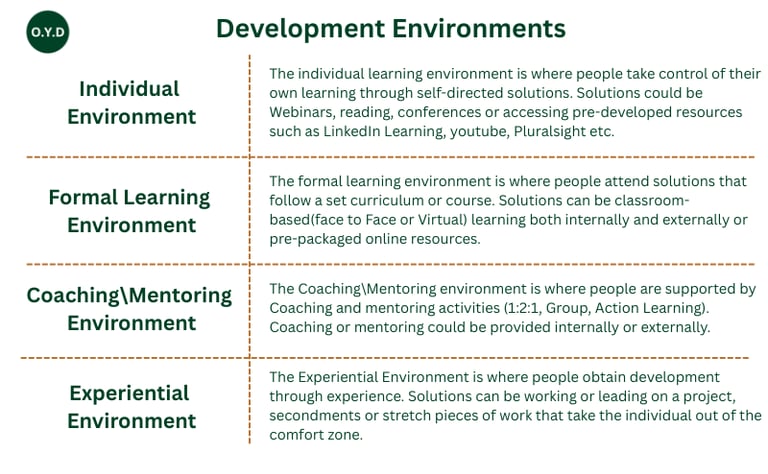
Development Environments
Our framework highlights how Individual, Formal, Coaching/Mentoring, and Experiential environments each play a vital role in the journey from unawareness to mastery. When sequenced and tailored as interlocking layers, they unlock the deepest forms of human potential.
Why It Matters:
Each environment contributes uniquely to skill acquisition, behavioural change, and performance acceleration.
Blended, cyclic, and recursive learning experiences foster long-term development and adaptability.
Strategic design, leadership sponsorship, and technology integration are essential enablers.
Evaluation must evolve—tracking not just participation, but real-world skill transfer and impact.
Neuroscience confirms: layering aligns with how the brain best learns, retains, and applies complex skills.
As the pace of change accelerates, progressive layering offers a reliable blueprint for building future-ready, resilient organisations, leveraging the full spectrum of learning, from reflective inquiry to transformative action


Get in touch
If you want to discuss how we can help with your skills transformation drop us a message