
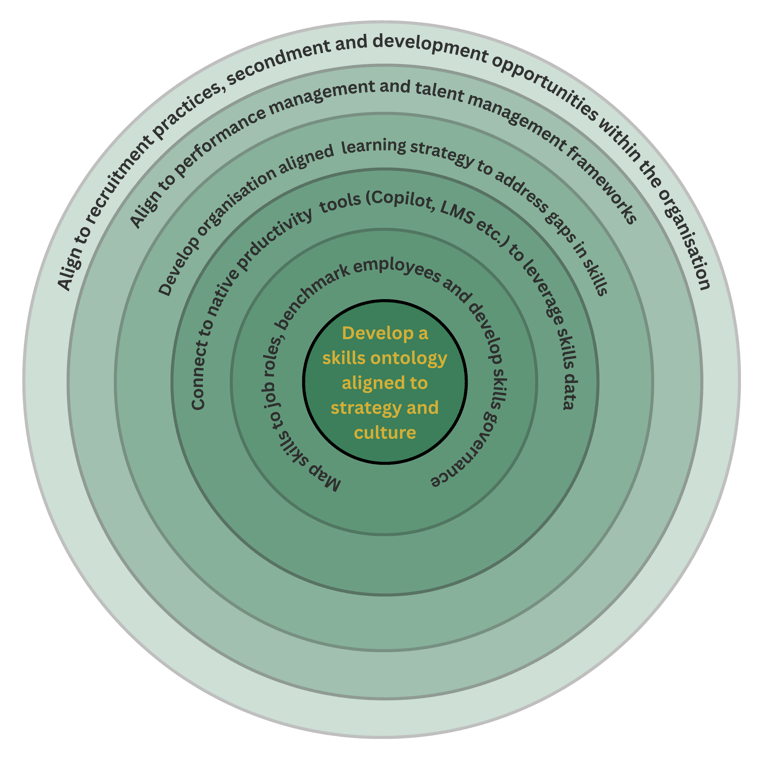
Stage 1: Develop a Skills Ontology aligned to strategy and culture
Establish a shared language of skills across the organisation by creating a skills ontology that reflects strategic priorities, cultural values, and future capability needs. This foundation enables consistent classification, measurement, and development of skills across roles and functions.
Stage 2: Map skills to Job Roles, benchmark employees, and develop skills governance
Translate the ontology into role-specific skill profiles and assess current workforce capabilities. Benchmark employees against these profiles to identify gaps and strengths. Introduce governance structures to ensure skills data remains accurate, relevant, and embedded into decision-making processes.
Stage 3: Connect to native AI Tools (Copilot etc.) to leverage skills data
Integrate your skills framework with AI-powered platforms to surface insights, automate recommendations, and personalise development pathways. Tools like Copilot can enhance productivity, support learning in the flow of work, and unlock real-time visibility of skills across the organisation.
Stage 4: Develop Strategically aligned Learning Strategy to address gaps in skills
Design targeted learning interventions that close priority skill gaps and build future capabilities. Align learning to business outcomes, using blended, experiential, and digital formats that are scalable and inclusive. Ensure learning is continuous, contextual, and measurable.
Stage 5: Align to Performance Management and Talent Management frameworks
Embed skills into performance conversations, career pathways, and succession planning. Shift from role-based evaluations to capability-based growth, enabling more agile, fair, and future-ready talent decisions. Use skills data to inform promotions, development plans, and leadership pipelines.
Stage 6: Align to Recruitment practices, secondments, and development opportunities
Use skills intelligence to guide hiring, internal mobility, and career development. Recruit for potential and transferable capabilities, not just experience. Create secondment and stretch opportunities that build critical skills while supporting retention and engagement
Owning your development isn't just for individuals. We also want organisations to own the development of their people, by understanding where skill gaps maybe in the workforce.
Benefits of Skills-Based Organisations
107% more likely to place talent effectively
57% more likely to anticipate and respond to change
52% more likely to innovate
Only 14% of executives say they fully leverage employee capabilities
Improved employee wellbeing and engagement
Enhanced diversity, equity, and inclusion
Future-proofing the workforce
Increased internal mobility and career progression
At O.Y.D we believe that transforming your organisation into having a skills focus can be achieved easily when planned properly. Our experience and six stage process can support and guide you into making this transition .
Skills Transformation Consulting
You may not be ready for all 6 stages, that's ok! This can be done incrementally.
Contact us to discuss your skills transformation to see how we can help
Get in touch
If you want to discuss how we can help with your skills transformation drop us a message